
Blocked valley channels
Leaves, moss fragments, broken mortar or displaced material can slow the flow and make rainwater back up beneath the adjacent covering.
Repair-first valley leak investigation
Local help with leaking roof valleys, damaged or blocked channels, cracked valley liners, lead valley defects and water ingress where tiles or slates meet the valley.
Send safe roof photos, your full postcode, and whether water is currently coming in via WhatsApp. Photos help Jamie understand the issue before he confirms the next step; never climb onto the roof.
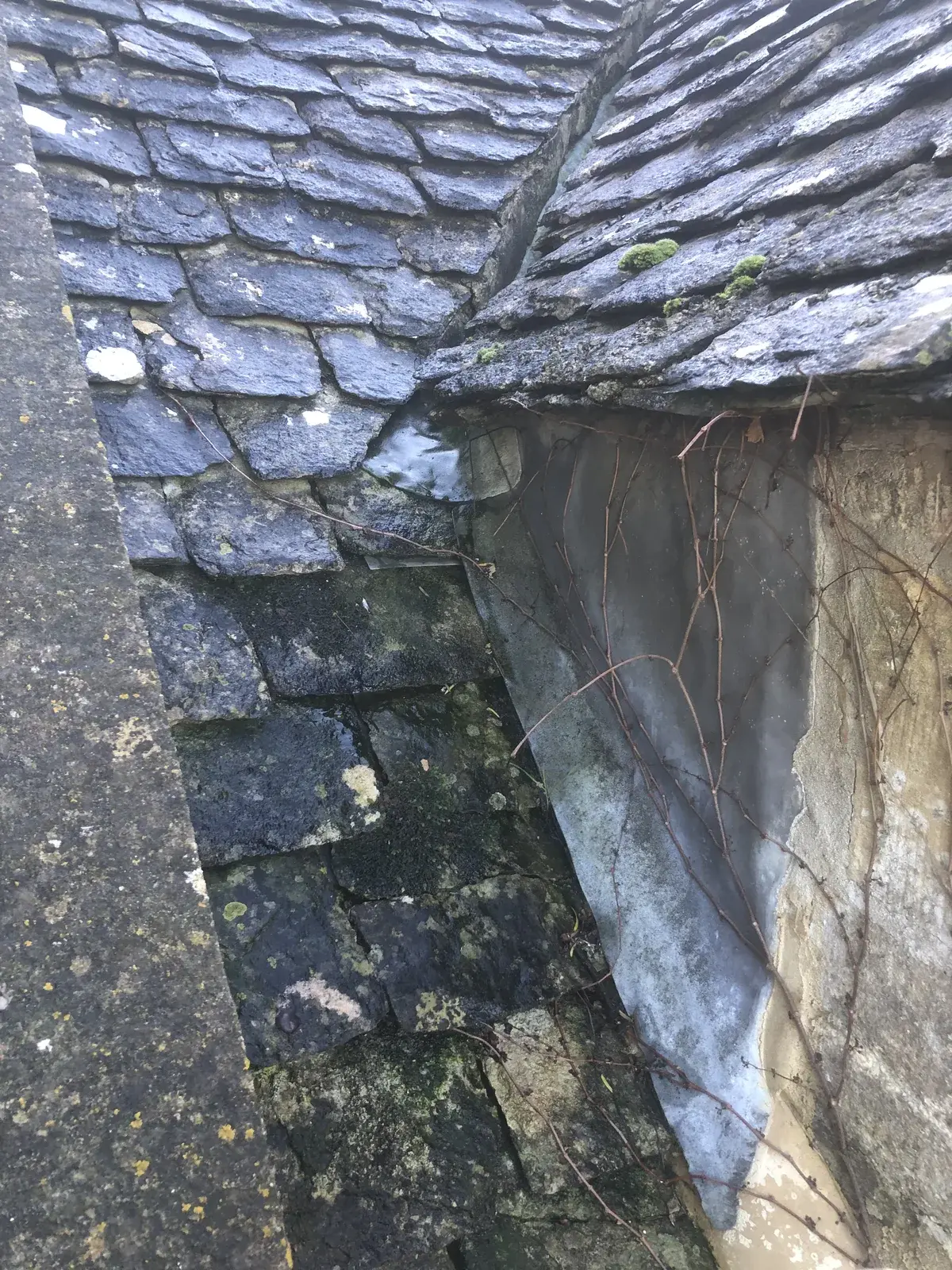
A proportionate approach
A roof valley carries rainwater from two adjoining slopes, so a local defect can admit a significant amount of water. Vallano Roofing investigates the valley itself, its edges and the nearby tile or slate covering before recommending work.
A leaking valley does not automatically mean the whole roof needs replacing. Where the defect is localised and the surrounding roof remains serviceable, Vallano prioritises a clearly scoped repair rather than pushing unnecessary replacement.
Photos help us understand the visible issue before Jamie confirms the next step, but they cannot show every concealed lap, fixing, underlay or supporting timber. A safe inspection may be needed before a cause or quote can be confirmed.
Valley fault-finding
The visible symptom does not always identify the entry point. Read how Vallano approaches a roof leak investigation.
Leaves, moss fragments, broken mortar or displaced material can slow the flow and make rainwater back up beneath the adjacent covering.
Lead, metal, GRP or other valley materials can split, crack, corrode or fail at a lap, depending on their age, installation and movement.
Poorly supported cuts, slipped coverings, failed fixings or gaps beside the channel can allow water past the intended weathering detail.
Water can enter at the valley head, a dormer, flashing or another junction and track towards the internal mark, so the obvious wet area is not always the source.
What to look for
Observe the roof and any internal marks only from a safe position. Never climb onto the roof or try to clear a valley yourself.
Staining on a ceiling, in a loft or where two roof slopes meet can justify investigation, although water may travel before it becomes visible inside.
A split liner, displaced valley section, failed lap or gaps where tiles or slates meet the channel can provide a route for wind-driven rain.
Leaves, mortar fragments or slipped coverings can restrict the channel. Overflow marks or water appearing mainly in heavy rain may indicate that the valley is not draining as intended.
From enquiry to scope
Review when and where water appears, the rainfall and wind conditions, internal staining and safe photographs before deciding what needs closer inspection.
Check the accessible valley lining, laps, top and lower outlets, surrounding tiles or slates, mortar or cut edges, flashings and visible supporting layers.
Separate a local valley defect from water arriving from a higher junction, then explain the confirmed findings and proposed repair scope before work starts.
Repair scope
The suitable method follows the valley material, confirmed fault and surrounding roof condition.
Repair or renew a confirmed local section where the material and surrounding condition make that approach suitable.
Repair or replace defective lead details using a scope appropriate to the confirmed split, failed lap or junction.
Securely reinstate or replace affected coverings beside the valley and address confirmed local defects in fixings, battens or underlay.
Remove accessible obstructions as part of an agreed repair where debris is contributing to restricted flow, without presenting this as a roof-cleaning service.
Related details may also involve roof leadwork repairs, slate roof repairs or tile roof repairs. If high winds displaced the covering, see storm damage roof repairs.
Water flow and weather
A valley concentrates water from two roof slopes into one channel. During prolonged or wind-driven rain, restricted flow, a failed lap, a crack or an open edge can be exposed to more water than it receives in a light shower.
Water may also arrive from a defect higher up and follow the valley or supporting layers before appearing indoors. That is why Vallano traces the likely route of water instead of assuming that the first visible mark proves the cause.
Safe wide and closer views can provide useful context. Use the roof problem photo checklist and let Jamie confirm whether an inspection is needed.
Repair first
Vallano Roofing handles small and targeted roof repairs. If the valley defect can be addressed locally and the surrounding covering remains serviceable, the proposed scope will focus on that repair rather than a full roof replacement.
If inspection shows wider deterioration, Jamie will explain what was found and why a larger scope may be needed. No repair is diagnosed or guaranteed from photographs alone.
Priority local service areas
Vallano Roofing welcomes roof valley enquiries from Christleton, Rowton, Waverton, CH3 and surrounding Chester areas. Choose your village for local roof-repair information and relevant completed-work evidence.
Read local roofing guidance and see how Vallano approaches roof repair enquiries from homeowners in Christleton.
Roof repairs in Christleton →Read local roofing guidance and see how Vallano approaches roof repair enquiries from homeowners in Rowton.
Roof repairs in Rowton →Read local roofing guidance and see how Vallano approaches roof repair enquiries from homeowners in Waverton.
Roof repairs in Waverton →Useful answers
The correct recommendation depends on the detail and condition found at the property.
Damp near the meeting line of two roof slopes, staining after heavy rain, visible cracks or displaced coverings can justify investigation. The internal mark may not sit directly below the entry point, so the cause needs to be traced.
A local repair may be suitable in some cases, but the liner material, position and extent of deterioration must be checked. A wider defective section may require a different scope.
Yes. Debris can restrict the channel and make water back up beneath adjacent tiles or slates. The valley and surrounding details should still be checked rather than assuming clearance alone will resolve the leak.
Photos help Jamie understand the issue and decide the sensible next step, but they may not show concealed laps, supporting layers or where water first entered. A safe inspection may be required before a quote is confirmed.
Yes. Vallano Roofing welcomes roof valley repair enquiries across Christleton, Rowton, Waverton, CH3 and surrounding Chester areas, subject to access and availability. No emergency attendance time is guaranteed.
Roofing advice from Vallano
A safe, practical checklist of the photos that help Jamie assess a roof problem, and what never to do. Send them by WhatsApp with your postcode.
Read the roofing adviceHow a roof leak is traced: why the stain isn't always below the entry point, what weather and timing tell us, and what photos can and can't show.
Read the roofing adviceImmediate, practical steps when a roof leaks: stay safe, limit internal damage, record what happened and send useful details for an initial review.
Read the roofing adviceWhat slipped or missing roof tiles can mean, warning signs to look for safely, when repair is needed and which photographs help with an initial review.
Read the roofing adviceNeed help with roof valley repairs?
Send safe roof photos, your full postcode, and whether water is currently coming in via WhatsApp. Jamie will review the details and confirm the sensible next step.